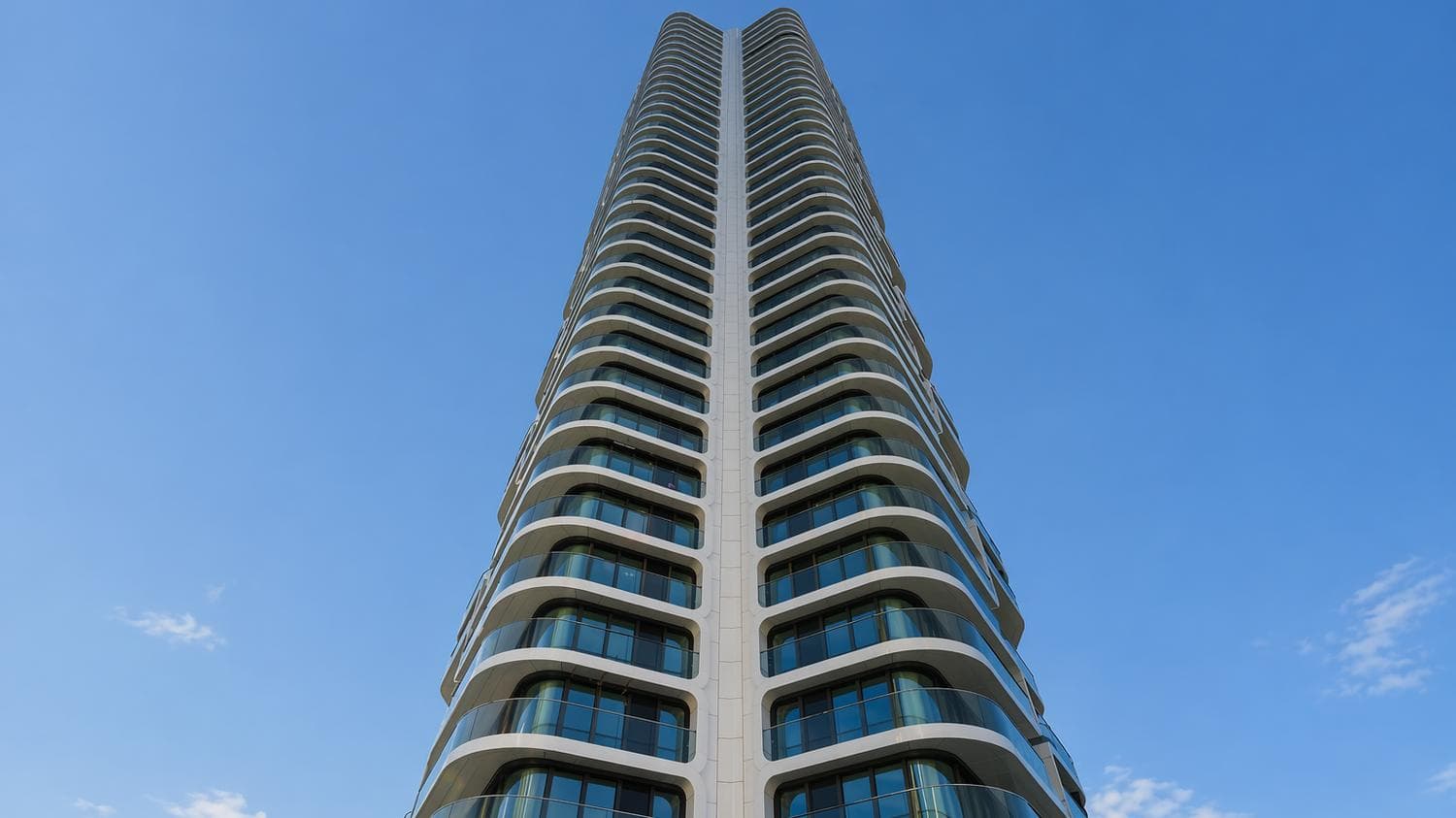
Luxury apartments in Frankfurt am Main, a buyer's field guide
Frankfurt's luxury apartment market is four distinct tiers, not one. Westend classical villas, Bankenviertel premium post-war blocks, Europaviertel residential towers, Nordend premium low-rise. Portal category pages (ImmoScout24, Immowelt) conflate them and roughly a fifth of inventory in each tier trades off-market. Grand Tower, on Europa-Allee 2 in the Europaviertel, is the tallest pure-residential ownership tower in Germany at 180 metres, completed 2020. The tier map, not the price per square metre, is the useful frame for a buyer.
The portal category pages are misleading in one specific way. They put a 1920s Westend villa, a 2023 Europaviertel tower, and a rebuilt Bankenviertel penthouse into the same list because all three get tagged the same keyword. A buyer reading that list comes away thinking Frankfurt's luxury apartment market is one market. It is not. It is four, and they behave differently.
This is a resident's map of the four tiers, written from the 41st floor of Grand Tower, where I have lived since 2023. Not a listing aggregator. The honest version of the tier frame that ImmoScout24 and Immowelt collapse.
The four tiers
Westend classical
The pre-war villas and Gründerzeit apartment houses along Grüneburgweg, Liebigstraße, Untermainkai. Ceilings near 3.5 metres, parquet original, stucco intact, courtyards private. The top tier of this segment is German family money trading through notary networks as often as through portals. Restoration quality varies; a restored unit with original floor plan is a different price from the same unit with a 1990s kitchen and false-ceiling work.
Bankenviertel premium
Mid-century and classic 1960s–1970s blocks around Taunusanlage, Bockenheimer Landstraße, the corridor between the Opera and Alte Oper. The Opernturm's residential sliver. Newer product like the restored prewar on Bleichstraße. Smaller floorplates than the Westend classicals and closer to the financial centre, which is the point. The buyer pool is cosmopolitan with a meaningful share of banking-sector relocators.
Europaviertel towers
The residential towers on former freight-yard land west of Hauptbahnhof. Grand Tower (180 m, 2020), Praedium (110 m, 2018), ONE FORTY WEST (145 m, 2021), Axis Tower (90 m, 2019). A 2010s masterplanning product that reached critical mass around 2018. Floor plans more efficient than the classicals, typically 90 to 140 m² versus 140 to 220 m² in the Westend. Hausgeld higher because the amenities are real. Resale narrower but active. See Europaviertel Frankfurt, a resident's guide for what the neighbourhood feels like day-to-day.
Nordend premium
Low-rise, smaller blocks, five to seven storeys, around Holzhausenpark and Oeder Weg. Quieter, older-money quarter. Resale slower but exceptionally reliable. A different buyer than the tower or classical tiers; families more often than corporates, holding longer than the banking cohort.
What the portal categories miss
The ImmoScout24 "Penthouse & Luxuswohnungen in Frankfurt am Main" page is useful for price-signal. Not useful as a tier map. Three specific gaps:
- Penthouse vs high-floor. The portal tags a 7th-floor Westend flat "penthouse" if the floorplan is the top of its building. It tags a 44th-floor Grand Tower unit the same way. These are not the same product. Read the floor number, not the label.
- Off-market is invisible. The top fifth of the price range in any tier trades privately. Portal category pages do not show it. A buyer looking only on-market is watching the bottom four-fifths of a market they think they are watching whole.
- Orientation and floor are barely filterable. A south corner at 41 and a north flank at 12 can list at the same headline per-m² number but the lived apartment is not the same. Portal filters collapse the distinction.
Three specific gaps, three specific mistakes that follow from them. A buyer who relies on category pages alone tends to overweigh price and underweigh orientation, floor, and governance.
The residential tower list
For the tower tier specifically, the one most international buyers look at first, this is the list as of April 2026.
| Building | Height | Completed | Use | Residential floors | Notes |
|---|---|---|---|---|---|
| Grand Tower | 180 m | 2020 | Pure residential ownership | 47 | Tallest residential ownership tower in Germany |
| FOUR T1 | 228 m | 2026–2028 phased | Mixed (office, resi, hotel) | ~20 upper floors residential | Phased handover |
| Praedium | 110 m | 2018 | Pure residential ownership | 36 | Mattheußer-developed, Europaviertel |
| ONE FORTY WEST | 145 m | 2021 | Mixed (hotel, resi) | 19 upper residential | Adjacent to Messe |
| Axis Tower | 90 m | 2019 | Pure residential ownership | 27 | Smaller block, Europaviertel edge |
| EDEN Tower | 98 m | 2024 | Resi, hotel | 27 | Biophilic façade, Niederrad edge |
Building-level comparison for Grand Tower specifically lives in the honest resident guide. Floor-by-floor altitude notes are in above 150 metres in a Frankfurt tower. The hub is high-floor skyline living.
What actually matters when buying
Price per m² is what every buyer opens with. It is, in this market, the least informative number. Four things matter more.
- Orientation. A south corner at altitude is a different apartment from a north flank at the same floor. The south-corner premium in the tower tier runs about a tenth to an eighth and is defensible on resale.
- WEG governance. A well-run Verwalter, healthy reserve fund, and clean ten-year maintenance plan are worth a percent or two on resale over a holding lifetime. Most brochures do not mention governance. The annual WEG report and the last three years of minutes are where it lives. Ask for them.
- Hausgeld line-items. What the concierge costs. What the amenity floors cost. What the reserve contribution is. A Hausgeld that looks high but is 8 per cent reserve is a different animal from a Hausgeld that is the same total but 1 per cent reserve.
- Floor height and ceiling. Classicals run 3.2 to 3.8 metres. Towers run 2.6 to 2.85. Noticeable. Brochures show photography, not ceiling height.
Why off-market exists at this tier
The upper tenth of each tier has enough discretion concern that private sale is the default. The reason is not secrecy for its own sake. It is that the buyer pool is narrow, the price is specific, and a public listing runs the risk of printing a discount signal. The sell-side understands this. Buyers not yet plugged into the private channel see the bottom seventy per cent and none of the top thirty. See the quiet market for how this actually works in Germany.
A closing note
The four-tier map is what the portal categories collapse into a single list. The honest version is useful when shopping and more useful when negotiating. A broker may or may not know which tier a specific unit belongs to; a resident does.
The 41st floor of Grand Tower is offered to a small pool of qualified buyers. The enquiry form is on the homepage.
External references: Grand Tower on Wikipedia, skylineatlas on Grand Tower.
Frequently asked questions
- How many luxury apartment tiers actually exist in Frankfurt?
- Four, not one. Westend classical villas (mostly pre-1930), Bankenviertel premium blocks (1920s to 1970s), Europaviertel residential towers (2015 onwards), and Nordend premium low-rise. The portal category pages lump them; a buyer should not.
- Which is the tallest residential ownership tower in Frankfurt?
- Grand Tower, 180 metres, on Europa-Allee 2 in the Europaviertel, completed 2020. FOUR Frankfurt has taller towers but they are mixed-use, not pure residential ownership.
- What are the selling prices per square metre for luxury apartments in Frankfurt's Europaviertel towers?
- In the bands we have personally seen trade, Europaviertel residential towers run roughly €12,000 to €18,000 per m². Floor, orientation, and whether the unit moves on- or off-market account for most of the spread. The upper half of that range is almost entirely private; portal listings sit in the lower half. Grand Tower, as the tallest pure-residential tower in Germany, trades at the upper end of the band; Praedium, ONE FORTY WEST and Axis Tower populate the middle.
- Are ImmoScout24 and Immowelt reliable sources for this market?
- For on-market listings, yes. For the tier map and for the top of each tier, no. Roughly a fifth of the highest-priced units in any tier trade privately and never appear on a portal.
- What should a buyer check beyond the headline price?
- Orientation, owners' association governance, reserve fund health, and the Hausgeld line-item split. A broker brochure volunteers none of these; the annual WEG report and the last three years of minutes are where a buyer learns them.
- Why is off-market so common at this tier?
- The buyer pool is narrow, the price is specific, and a public listing runs the risk of sending a discount signal even when the market is strong. The sell-side understands this. See the quiet-market piece linked in the article for how it works in practice.
Read deeper
The journal cluster extends this pillar with single-topic posts. Start with the cluster overview or jump straight to a post.
High-floor skyline living
What it is actually like to live above 100 metres in Frankfurt. Weather, light, sound, seasons, and the psychological experience of altitude residential.
What an apartment in Frankfurt's residential towers costs, the 2026 comparison
What an apartment in Frankfurt's residential towers costs: FOUR, RIZON, One Forty West, Grand Tower, Eden Tower and Henninger Turm compared per square metre, normalised to height.
The Spin and the 41st Floor
The Spin stands next to Grand Tower and clips the skyline for most floors below 40. Where the sightline clears, and what changes when it does.
Above 150 metres: what changes when you live in the top third of a Frankfurt tower
Light, sound, weather, sight-lines. What actually shifts when a Frankfurt apartment sits above the 150-metre line — a resident's read, not a brochure.