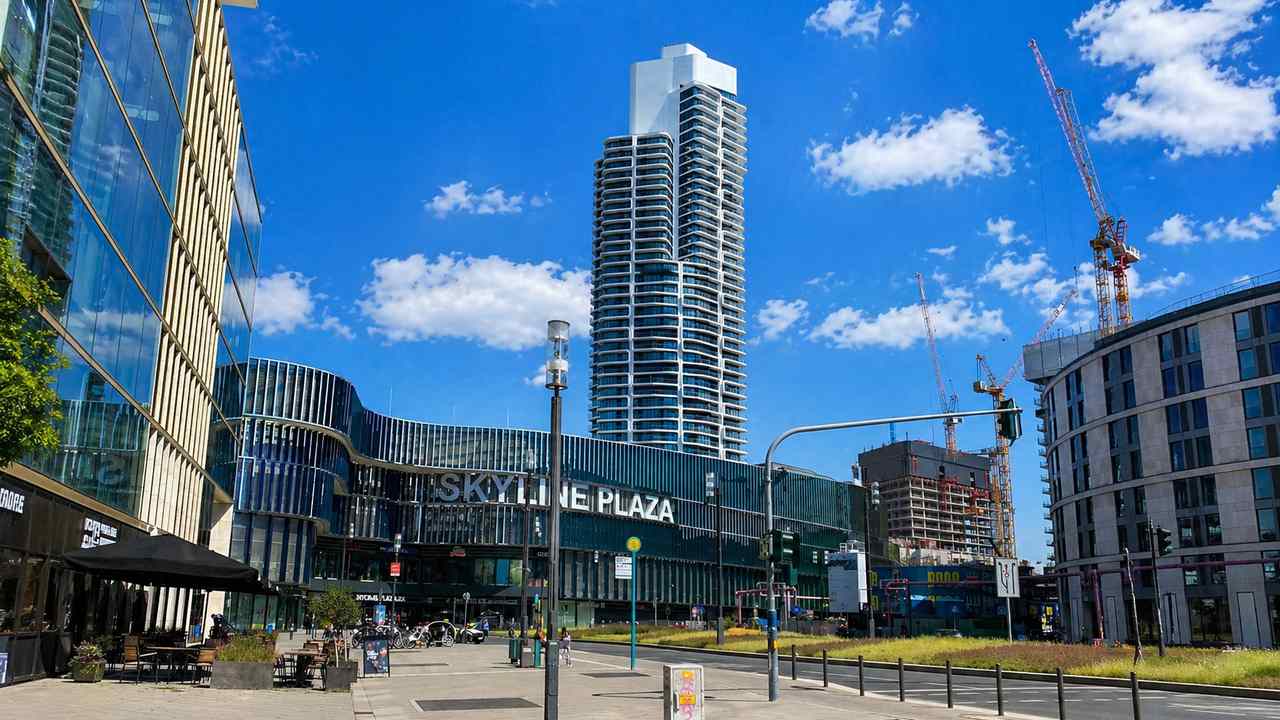
Gallus, Frankfurt, the district behind the Europaviertel towers
Gallus is the older, partly working-class Frankfurt quarter on which the Europaviertel was masterplanned. Both sit inside postcode 60327 but read as two different districts at street level. Grand Tower is technically in Gallus; its lobby faces the Europaviertel. The Gallus layer explains what a resident walks through between Mainzer Landstraße and Europa-Allee, and why the name still matters socially even as the masterplan overwrites it visually.
A ten-minute walk from the Grand Tower lobby shows you why Gallus and Europaviertel are two districts in one postcode. You cross Mainzer Landstraße, the visual grammar changes. The new masterplan ends. The older Frankfurt begins. Both are 60327. Both are in "Frankfurt Main" for the portal category pages. Neither is the other.
This piece is the layer the Europaviertel articles do not cover. Gallus is the quarter the masterplan was built on top of, and its social memory is what a tower resident walks through at street level. See Europaviertel Frankfurt, a resident's guide for the newer half.
What Gallus used to be
Gallus formed in the late 19th century as the industrial district west of the main station, along the freight lines that fed the Frankfurt Messe and the chemical works. The name is from Sankt Gallus, the hospital-church that gave the neighbourhood its social anchor. Through the 20th century Gallus was working-class Frankfurt; railway workers, factory workers, the immigrant layer that arrived with the postwar boom and stayed through the 1980s. It was not poor by Ruhrgebiet standards but it was never Westend.
The freight yards shut down in the 2000s. The land they sat on became the Europaviertel, on the northern edge of Gallus, and the district that the masterplan was laid over is what Gallus-proper still is today.
What it is now
Gallus runs from Mainzer Landstraße in the north to the railway tracks in the south, from Platz der Einheit in the east to the Kleyerstraße industrial corridor in the west. Roughly a square kilometre, densely built, mostly residential, with pockets of light industry along Kleyerstraße and around the old Wagenhallen.
The northern edge, Frankenallee, Idsteiner Straße, Günderrodestraße, is where gentrification has moved fastest. Pre-war Gründerzeit blocks, restored façades, independent bakeries, Turkish grocers that have been there thirty years sharing a block with a new wine bar. The southern edge, Rebstöcker Straße, Niddastraße toward the tracks, still reads like the older Gallus: working-class, immigrant layer, small service businesses, kebab places that are not performatively good.
The distinction matters. A buyer at Grand Tower walking south crosses Mainzer Landstraße within three minutes and is in the older Gallus by five. Walking east the same five minutes keeps them in the new Europaviertel. Same postcode, different walk.
Why the Gallus name matters
The Europaviertel masterplan did not erase Gallus. It folded it. Administratively both sit inside Bezirk 01 (Innenstadt) and share the 60327 postcode. Socially, the Gallus name is still the one the older residents use for the whole area, including the new towers. Ask a Frankfurter of 60 where Grand Tower is and you will hear "im Gallus" more often than "im Europaviertel".
That naming tension is a small but real marker of who the neighbourhood belongs to. The Europaviertel masterplan is the 21st-century product; Gallus is the 19th-century root. A Grand Tower owner who learns the Gallus layer has a district, not just a tower.
Street-by-street, the five that matter
- Mainzer Landstraße, the spine between Gallus and Europaviertel. Not beautiful. Heavy traffic. The S-Bahn station (Frankfurt-Galluswarte) is the northern edge. Every resident crosses it often; few linger on it.
- Frankenallee, the Gallus-proper main artery. Tree-lined, pre-war blocks, the district's café-and-grocery corridor. This is where the neighbourhood feels like a neighbourhood, not a masterplan. Good anchor point for a newcomer.
- Idsteiner Straße, residential, quieter, mixed-use. The unshowy middle of Gallus. A weeknight walk here gives the honest read of the quarter.
- Kleyerstraße, the light-industrial edge. Workshops, the old Wagenhallen, a handful of maker spaces. Not a walking street but a useful reference for how Gallus still differs from any Westend street.
- Günderrodestraße, the park-adjacent residential stretch near Hafenpark-Gallus. Quieter, family-heavy, the direction Gallus has been evolving for a decade.
The five streets together are what a Grand Tower resident actually uses to know the district. None of them appear in a broker brochure; all of them appear in the lived week.
Who lives in Gallus
The social mix is broader than any of the classical luxury districts. Longtime working-class families who have held apartments since the 1970s. A meaningful Turkish and Balkan-origin layer from the postwar immigration. Younger Frankfurt professionals priced out of Westend and Nordend. Artists who moved in when Kleyerstraße rents were still low. A small but growing layer of new-money buyers near the Europaviertel edge.
This is not the Westend. It is also not Nordend. It is an in-transition quarter where the gentrification vector is one-directional but the clock is real, the older layer has not yet been priced out, and a decade of the Europaviertel next door has not flipped the whole postcode. A Grand Tower buyer walking Frankenallee will see more kinds of people in ten minutes than on the equivalent Westend walk.
Why this matters for a Grand Tower buyer
Two reasons. First, a tower resident does not live only in the tower. They live in whatever they walk through to get to Skyline Plaza, to the S-Bahn, to a Saturday-morning bakery. For the 41st floor of Grand Tower, that walk is partly Europaviertel and partly Gallus, and the Gallus part is what most brochures skip. Knowing the distinction makes the apartment a better home.
Second, the district's trajectory is part of the address's long-run value. Gallus is still catching up on the Europaviertel premium. A decade out, the postcode will probably price like one district rather than two, which is a quiet upside on any unit in either half. See Europaviertel in 2035 for the longer read on how the whole 60327 footprint evolves.
The sibling posts are the U5 extension piece for the transport angle and the Europaviertel hub for the full district set. The pillar for these notes is Europaviertel Frankfurt.
A closing note
Gallus and Europaviertel are two districts in one postcode, merging slowly. A resident of either lives in both. The 41st floor of Grand Tower is offered to a small pool of qualified buyers. The enquiry form is on the homepage.
External references: Gallus on Wikipedia, Frankfurt city statistics for Bezirk 01.
Frequently asked questions
- What is the difference between Gallus and Europaviertel?
- Historically the same area. Gallus is the older, partly working-class quarter south and west of Mainzer Landstraße. Europaviertel is the 21st-century masterplanned district built on former freight-yard land to the north and east of it. In the 2020s the two are merging socially; the postcode is the same.
- Is Grand Tower in Gallus or Europaviertel?
- Both, depending on which map you read. Postally it sits at Europa-Allee 2, 60327, which is the Gallus postcode. Urbanistically it is the flagship of the Europaviertel masterplan. Residents use both names; context decides.
- Is Gallus a safe district?
- Yes, with caveats by street. The core residential streets are quiet. The edge toward Hauptbahnhof and parts of Mainzer Landstraße at night read busier. The Europaviertel-adjacent north is the calmest part of 60327.
- Is Gallus gentrifying?
- It has been for a decade. Rents along Frankenallee, Idsteiner Straße, and Kleyerstraße have risen sharply since 2015 as the Europaviertel build-out matured. The social mix is still broader than Westend or Nordend but the direction is one-way.
- What is the Gallusviertel Wagenhallen?
- The remaining industrial sheds in the southern Gallus, some reused for cultural and maker space, some still in light industrial use. They are a piece of the district's pre-masterplan character that a Europaviertel resident can walk to in ten minutes.
Read deeper
The journal cluster extends this pillar with single-topic posts. Start with the cluster overview or jump straight to a post.
Europaviertel Frankfurt, the neighbourhood notes
A resident's field notes on Europaviertel Frankfurt: transport, Skyline Plaza, Europagarten, family life, comparisons to Westend, Nordend, Ostend, Gallus.
Buying an apartment in Europaviertel Frankfurt, new-build stock in the city's youngest quarter
Buying a condominium in Frankfurt's Europaviertel: what the new-build stock actually offers, which floor plans matter, what the closing costs are, and what the closing costs actually come to.
Europaviertel in 2035: reading a neighbourhood that is still finishing itself
A district half-built on former railway land, maturing into something closer to Hamburg's HafenCity than to Gallus. What Europaviertel will read like in ten years.
Europaviertel in 2027: what the U5 extension changes for Grand Tower
A new U-Bahn station at Güterplatz, a €515M programme, and the quiet pivot of central Frankfurt. Here's what the 2027 completion actually means for the Europa-Allee corridor.