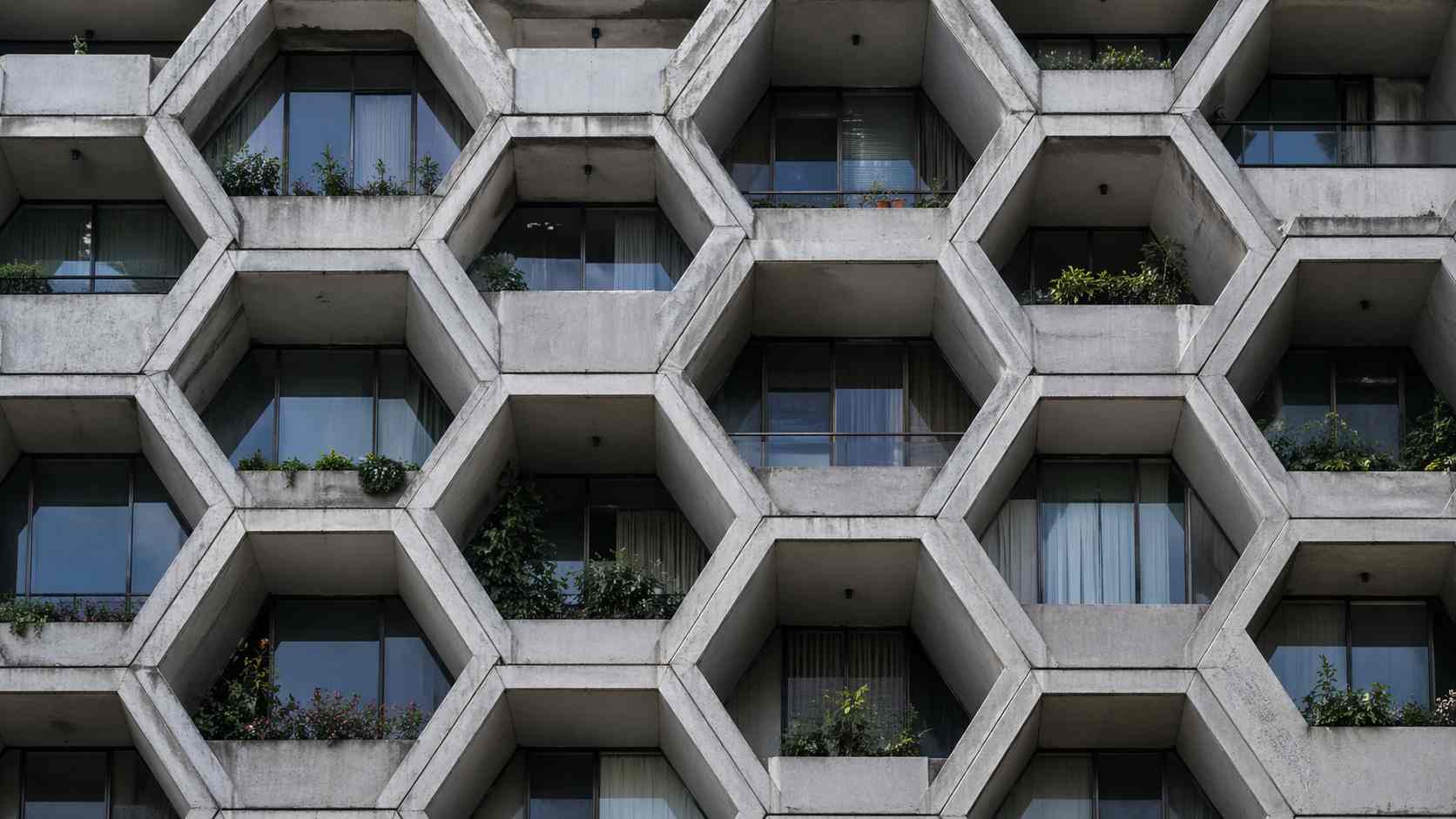
The honeycomb: how Grand Tower's façade is actually built
Look at Grand Tower from the west at golden hour. The tower reads as a vertical sheet of hexagons — a honeycomb pulled into two dimensions, with openings the size of a balcony, stacked fifteen to a column. It is the building's defining visual feature. It is also a piece of engineering most people never ask about.
Precast, not poured
Every balcony on Grand Tower is a precast concrete module. Factory-made offsite, trucked in, hoisted into position one storey at a time, and locked into the structural grid of the tower. There are hundreds of them, and they are not ornamental. Each hexagon is load-bearing: the balcony you stand on is part of the façade that stops your floor from moving.
This is a specific choice. Most high-rises cast balconies in place, or bolt them on as lightweight steel or aluminium trays. Precast concrete modules of this geometry are rare because they are expensive to produce, heavy to move, and unforgiving to install. You get one attempt at alignment; the factory has to have shipped you a geometric twin of the module next to it.
Why hexagonal
The hexagon is not a style statement. It is a structural one. Hexagonal cells distribute load across three axes instead of two — which is why bees build with them, and why honeycomb panels show up in aerospace. In a tall building, this means every floor's balcony is doing quiet work bracing the façade against wind, without needing additional visible structure.
From inside the residence, the structural upside is a practical one: the balcony "wraps" the corner in a single continuous module. There is no exposed beam. There is no column breaking the floor-to-ceiling glazing behind it. The thing you notice is what's missing — and that absence is the honeycomb doing its work.
The Kaminiarz signature
Magnus Kaminiarz's practice runs several tall Frankfurt projects, and Grand Tower is the clearest articulation of a house style: a single repeating geometric rule, applied ruthlessly, until the building becomes legible as one idea instead of forty. The honeycomb is that rule. Pushed up 180 metres, wrapped around every side, it resolves into a tower that you recognise from six kilometres away.
Why you will not see this on another Frankfurt tower
Two reasons. One is commercial: tall residential towers in Frankfurt have been built against tight margins for the last decade, and most developers trade façade cost for floor area. The honeycomb gives you less net floor area per euro than a flat glazed façade. It pays back in architectural identity — which is not a line item most pro formas accept.
The other is temporal. FOUR, Grand Tower's closest peer in scale, is a different formal programme. Neither of the towers under consideration for the next Frankfurt wave is proposing a hexagonal structural façade. Which means: until someone builds another Kaminiarz, Grand Tower owns the honeycomb.
For a resident, what this compresses into is very small and very specific: the balcony you step onto is not a feature. It is a structural signature of the building itself.
One of those balconies wraps the south corner of the 41st floor. The enquiry form for that residence is on the homepage.
Frequently asked questions
- How is the Grand Tower façade constructed?
- Each balcony is a precast concrete module, factory-made offsite, trucked in, hoisted into place one storey at a time, and locked into the structural grid of the tower. The modules are load-bearing rather than ornamental — they are part of what stops each floor from moving.
- Why hexagonal?
- Structural reasons, not stylistic ones. Hexagonal cells distribute load across three axes instead of two, which is why bees build with them and why honeycomb panels show up in aerospace. In a tall building this means every balcony braces the façade against wind without needing additional visible structure.
- Who designed Grand Tower?
- Magnus Kaminiarz & CIE, a Frankfurt practice. Grand Tower is the clearest articulation of the house style — a single repeating geometric rule, applied ruthlessly, until the building reads as one idea rather than forty stacked floors.
- Will other Frankfurt towers copy this façade?
- Unlikely. Precast concrete modules of this geometry are expensive to produce, heavy to move, and unforgiving to install — a single misalignment breaks the visible grid. Most high-rises cast balconies in place or bolt on lightweight trays instead.
- What does the honeycomb do for interiors?
- It wraps the corner in a single continuous module with no exposed beam and no column breaking the floor-to-ceiling glazing. The structural work is happening outside the line of sight, which is why corner units read as uninterrupted glass.
Read deeper
The journal cluster extends this pillar with single-topic posts. Start with the cluster overview or jump straight to a post.
Grand Tower Frankfurt, the building notes
Long-form resident notes on Grand Tower Frankfurt: concierge, amenities, floor differences, facade, Hausgeld, and honest comparisons to FOUR and EDEN.
What does one floor higher cost at Grand Tower?
How sharply the price per square metre climbs with the floor at Grand Tower: the first-sale price curve as an index, the step at floor 31, and the penthouse threshold at 43.
A penthouse at Grand Tower Frankfurt, or the 41st floor below it
Penthouse at Grand Tower Frankfurt or the highest standard floor below it: what actually changes between the levels, in layout, view, price and resale.
Grand Tower Frankfurt prices: what an apartment actually costs
Grand Tower Frankfurt prices: the per-square-metre band, why floor and orientation explain almost the whole spread, plus Hausgeld, Grundsteuer and closing costs.